

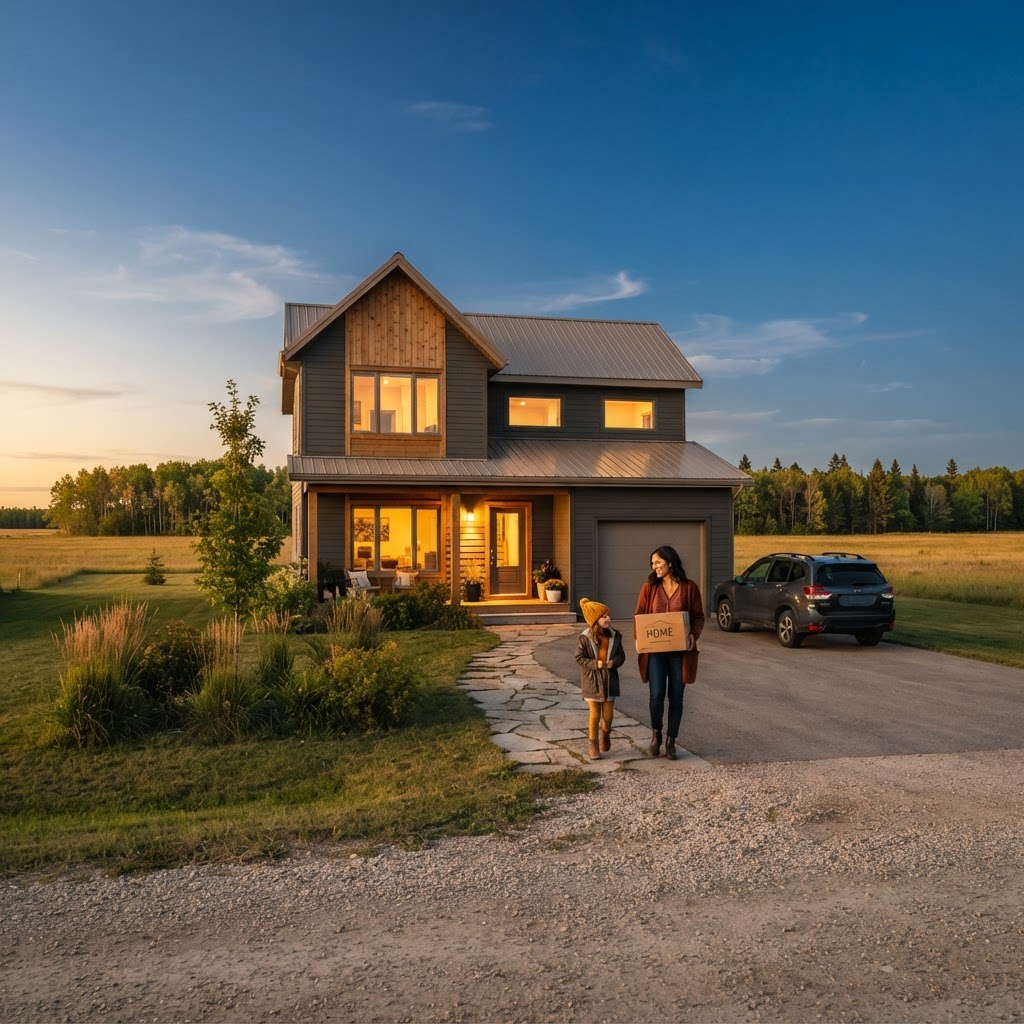
Indigenous and Métis homeownership in Manitoba is supported by programs built specifically to close the down payment gap for First Nations and Métis families. Getting there means looking at three layers: Métis-specific down payment funding, First Nations homeownership programs, and the federal savings tools that work alongside both.
This guide walks through the programs available in Manitoba right now, who each one is built for, and the practical steps that keep an application on track. Every program sets its own rules and updates them from intake to intake, so treat the details below as a starting point and confirm the current guidelines with the provider before you rely on a number. If you are new to the process itself, start with our first-time buyer guide, then come back to the funding side. The good news is that the pathways into Indigenous and Métis homeownership in Manitoba are broader than most buyers expect.
Métis Homebuyers: The MMF First Time Home Purchase Program
The Manitoba Métis Federation's First Time Home Purchase Program is delivered through Louis Riel Capital Corporation. It is designed for Red River Métis citizens who have never owned a home and who can qualify for a mortgage but cannot clear the down payment a financial institution requires. This is one of the two pillars of Indigenous and Métis homeownership funding in Manitoba, alongside the First Nations programs covered below.
In the current guidelines, the program provides a forgivable loan covering the down payment to a maximum of 5% of the purchase price, capped at $18,000, plus 1.5% of the purchase price toward closing costs, capped at $2,500. The funding is registered on title in second position at the buyer's cost, and the home must be your primary residence. If you are still mapping out how a mortgage file comes together, our guide to the Manitoba mortgage process covers that step by step.
Eligibility highlights: proof of Red River Métis citizenship through an MMF citizenship card, or a letter from the MMF Central Registry Office confirming a card is in process; age 18 or older; Manitoba residency; a mortgage pre-approval at application or within 30 days of approval into the program; no previous home ownership; no ownership interest in real estate worth more than $30,000; household gross income below $100,000 as shown on CRA notices of assessment; and combined liquid assets under $60,000. Priority is given to applicants currently in social housing and to families leaving situations of abuse or violence.
Property rules matter as much as personal eligibility when you are planning around Indigenous and Métis homeownership funding. Eligible homes include new builds with a new home warranty, resale single-family homes, townhouses, condominiums and multi-unit properties, ready-to-move homes on permanent foundations, and mobile homes on owned land with a permanent foundation. Life-lease homes, homes on leased or rented land, mobile homes in trailer parks and self-build projects are not eligible. The maximum purchase price is $600,000.
One rule catches buyers off guard: you cannot have an accepted offer to purchase before you are approved into the program, so hold off on making offers until your approval is in place. Applications are typically reviewed within about five business days when a file is complete, and an approval holds for 180 days, with extensions considered. If you are buying with a spouse or partner, they must be included as a co-applicant and meet the program criteria regardless of ancestry, and funding cannot be combined with the MMF Home Enhancement Loan Program.
First Nations Homebuyers: Manitoba Tipi Mitawa
Manitoba Tipi Mitawa is a partnership between the Assembly of Manitoba Chiefs and the Manitoba Real Estate Association, and it is the longest-running First Nations stream within Indigenous and Métis homeownership programming in the province. It pairs financial assistance with roughly 40 hours of education covering financial literacy, home maintenance and the purchase process itself.
In the latest published guidelines, the basic requirements are: you must be a first-time home buyer; the primary applicant must be a member of a First Nation and have lived in Manitoba for the past 10 years; you agree to a voluntary credit report; you have been continuously employed full-time for the past two years; household annual income, excluding social assistance, falls within the program's current band of $68,500 to $106,212; and you have a minimum $5,000 deposit. Homes must be at least two bedrooms and located within Winnipeg or Brandon city limits, with other major urban centres considered if the applicant completes all educational sessions. A mandatory home inspection must be done by a registered member firm of the Canadian Association of Home and Property Inspectors, and a Property Disclosure Statement must be requested from the seller of any property you make an offer on.
Spaces are released in intakes and the income bands and price limits have shifted between them, so work from the current guidelines rather than older numbers you may find online. A newer stream focused on First Nations women has also been funded, so it is worth asking what is open right now. Reach the program at tipimitawa@mrea.mb.ca or 204.772.0405 before you start touring homes.
Buying On Reserve: Guarantees and the Market Housing Fund
Financing a home on reserve works differently from buying in the city. Because reserve land is held collectively, most lenders cannot take standard security on the property, which is why guarantee programs exist in the first place. Indigenous Services Canada issues Ministerial Loan Guarantees to lenders for on-reserve housing loans, and CMHC insures qualifying on-reserve loans that are secured by one of those guarantees.
The First Nations Market Housing Fund takes a different approach. The Fund is not a lender: through its Credit Enhancement program it provides a 10% portfolio guarantee to approved loans, and it supports communities with training and homeownership navigator services as they build market-based housing. Members who want to buy, build or renovate on reserve should start with their Nation's housing department to find out whether their community works with the Fund. The Fund's mandate covers homeownership on reserve, including members who want to return home, while off-reserve purchases are served through other resources. That mix of guarantees, lenders and community programs is a large part of why Indigenous and Métis homeownership in Manitoba can look very different from one community to the next.
Federal Savings Tools That Stack With These Programs
Two federal tools help you build the cash a purchase needs, and they can be used together for the same home. The Home Buyers' Plan lets a first-time buyer withdraw up to $60,000 from an RRSP without paying tax at the time of withdrawal, and a couple can withdraw up to $120,000 between them; the amount is repaid into your RRSP over 15 years, with repayments beginning in the second year after the withdrawal. The First Home Savings Account is the other half: contributions of up to $8,000 a year, to a lifetime maximum of $40,000, are tax-deductible, and qualifying withdrawals are tax-free.
If you are applying to the MMF program, watch how those two tools interact with its thresholds. RRSPs, TFSAs and FHSAs all count as liquid assets, and combined liquid assets must stay under $60,000, which includes the money you plan to put toward the down payment and closing costs. Structuring your savings around that limit is part of preparing a strong application, and it is a good illustration of why the practical guidance on Indigenous and Métis homeownership in Manitoba starts with financing conversations rather than listings.
What to Have Ready Before You Apply
Most delays come from paperwork rather than from qualification. A strong application for Indigenous and Métis homeownership funding in Manitoba usually includes:
- A mortgage pre-approval from a mainstream or known financial institution, which the MMF program requires at application or within 30 days of approval
- Proof of citizenship, such as an MMF Métis citizenship card or confirmation of First Nation membership
- Recent CRA notices of assessment for everyone on the application
- Proof of continuous full-time employment
- A deposit for your offer, at least $5,000 for Tipi Mitawa
- Cash beyond what a program covers, since assistance rarely pays every closing cost. The MMF program recommends setting aside at least 3% of the purchase price, and our breakdown of closing costs shows what those dollars cover
Expect education to be part of the process too. Tipi Mitawa's sessions are a requirement rather than an optional extra, and they cover the parts of a purchase that surprise first-time buyers most: what a lender actually reviews, how maintenance costs behave in a Manitoba winter, and how to read an offer to purchase.
Choosing a Home That Qualifies
Assistance programs set rules about the property, not only about the buyer. Program-linked purchases generally cannot be life-lease units or homes on leased land, and inspections plus property disclosure documents are standard requirements. If you are shopping outside Winnipeg or Brandon, confirm the location rules before you fall in love with a house, and if you are buying in the city, browsing current Winnipeg listings alongside our Winnipeg buying guide will give you a realistic sense of what your approved price range buys. Two-bedroom minimums, permanent foundations and new home warranties all matter more than they would in an unassisted purchase, which is a practical reality of Indigenous and Métis homeownership programs in Manitoba.
Next Steps: Build Your Team Early
Start with the program, then the lender, then the REALTOR®. That order matters in Indigenous and Métis homeownership applications because an offer accepted before approval can disqualify you from the funding entirely. Ask about the current intake, get your pre-approval in motion, and gather your documents while you wait. When your approval is in hand, you can move quickly and compete for the right home with confidence. If you would like help mapping out which programs fit your situation, reach out and we can work through it together.
Indigenous and Métis homeownership in Manitoba is supported by more pathways than most buyers realize, and the programs are built to be used. Confirm the current details with the Manitoba Métis Federation, the Manitoba Tipi Mitawa program or your Nation's housing department, then take the first step while the intake is open.