

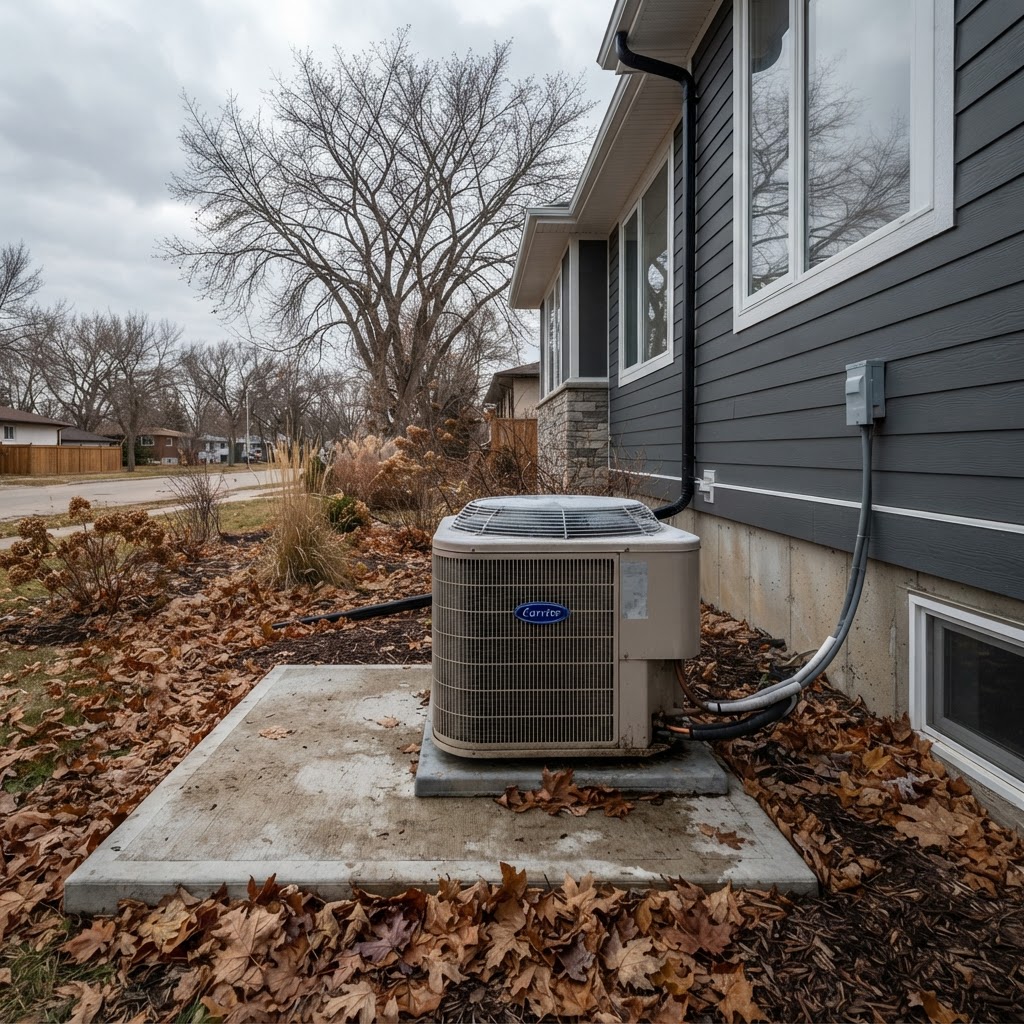
Central air winter shutdown is not something most Winnipeg homeowners think about until the first hard freeze, and by then the outdoor unit has already been sitting through a few frosty nights. The condenser on the side of your house is built to live outside, but it was not built for five months of -30°C nights, drifting snow, freeze-thaw cycles and mice looking for somewhere warm.
What you do in October decides what happens in May. A unit that goes into winter clean, dry, powered down and clear of the weather starts easily in spring. One that goes in full of leaves, wrapped in a plastic bag, buried in a drift or with a nest in the control compartment is a repair bill waiting for the first warm afternoon.
Here is the practical sequence for a Winnipeg fall, plus the one situation where every bit of covering advice below is exactly wrong.
Why the fall shutdown matters here
Our cooling season runs roughly from late May to September, and the shoulder season is short. The problems that show up in spring almost always start in the fall:
- Debris holds moisture. Poplar fluff, grass clippings and leaves packed into the coil stay wet, and wet debris against aluminum fins and a steel cabinet is how rust starts.
- Ice and snow load bend metal. Snow sliding off a roof, or a chunk of ice from an eavestrough, is enough to fold the top grille and bend the fan blades.
- Cold metal plus freeze-thaw seizes bearings. A fan motor that sat with moisture in it all winter often announces itself in June with a hum and no spinning.
- Mice move in. The cabinet is a warm, dry, sheltered box with wiring inside. Chewed control wiring is one of the most common spring no-cool calls in this city.
- A dirty coil strains the compressor. Restricted airflow raises head pressure, and the compressor is the most expensive part in the system.
None of this takes special tools. It takes an afternoon before the snow flies.
First, know which system you actually have
This is the fork in the road, and getting it wrong is expensive.
- Central air conditioner: cools only. The outdoor unit is idle from fall to spring. Shut it down and protect it.
- Heat pump: heats and cools, and the outdoor unit runs all winter. Do not shut off the power and do not cover it. A covered heat pump cannot breathe, and it will run itself to death trying.
How to tell the difference: check the model plate on the outdoor unit, look for “heat pump” or “auxiliary / emergency heat” settings on your thermostat, or look up the model number. A dual-fuel setup (heat pump outside, gas furnace inside) still counts as a heat pump. If you genuinely cannot tell, leave it powered and uncovered until someone qualified has looked at it, because running an air conditioner as if it were a heat pump only costs you comfort, while the reverse can wreck equipment.
Shutting down a central A/C, step by step
1. Stop using cooling before the cold sets in
Do not run the air conditioner when the outdoor temperature is below about 15°C. The compressor oil is cold and thick, lubricant does not circulate properly, and liquid refrigerant can find its way back into the compressor. Most modern thermostats lock out cooling around that temperature for exactly this reason. If you have been using the A/C into October, give it up before the first hard freeze and let the house ride on cool nights and open windows.
2. Set the thermostat to heat
Heat mode, fan on auto. Leaving the fan on “on” just moves cold, damp basement air around all winter and costs you money.
3. Kill the power at the outdoor disconnect
Beside the unit on the wall there is a small grey box, usually with a pull-out block or a lever. Pull the block out or switch it off, then turn off the air conditioning breaker in your electrical panel and label it. That gives you two layers of protection and a unit that cannot surprise anyone.
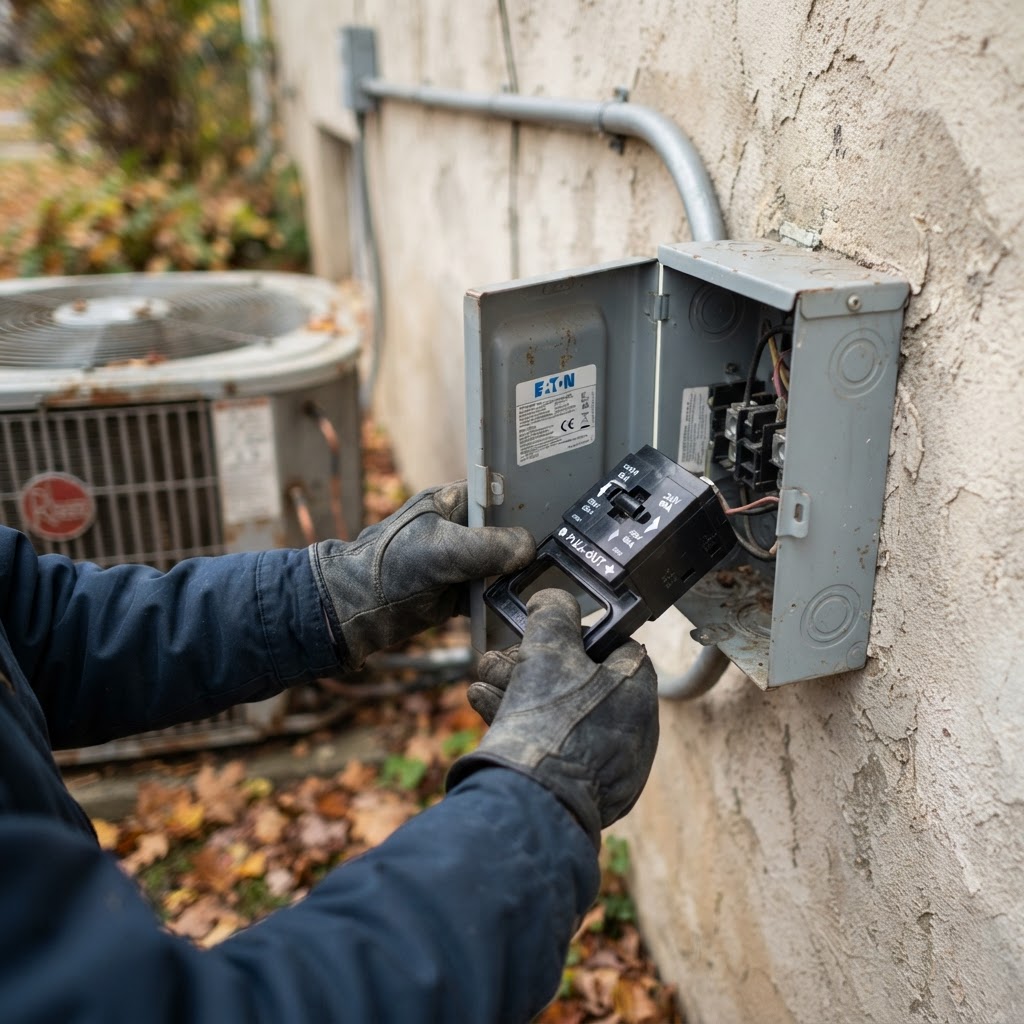
Do not open the electrical compartment on the unit itself, and never work inside the cabinet with power on: the capacitors in there hold a charge even after the disconnect is pulled. If something inside looks damaged, that is a call to a refrigeration technician, not a weekend job.
4. Inspect the cabinet before you wash anything
On a dry day, look through the grille with a flashlight. Clear leaves and grass from the base. Check for a nest or nesting material, and look at any wiring you can see for chew marks. Oil residue or a dark, wet patch around the service valves can mean a refrigerant leak, which is worth diagnosing before it becomes a spring emergency.
5. Wash the condenser coil, inside out
The coil is the finned surface wrapping the cabinet, and it is the whole point of the exercise. Use a garden hose at normal household pressure, never a pressure washer, which will flatten the fins into a solid sheet. Work from the inside of the coil outward so debris is pushed out the way it came in rather than packed deeper. A soft brush or a vacuum with a brush attachment first, if it is really caked, then rinse top-down. Keep water out of the electrical compartment and let the unit dry before you cover the top.
6. Straighten bent fins
A fin comb costs very little and takes ten minutes. Work gently in the direction of the fins. Flattened sections of coil are dead surface area for the life of the unit.
7. Check the line set insulation
The two copper lines running into the house should be wrapped in foam insulation, usually black. Sun rots it, squirrels chew it, and once it is cracked open the cold suction line sweats, drips and ices. Replace damaged sections before winter; foam insulation and zip ties are a hardware store purchase. Leave the service valves accessible and do not seal them up so tightly that water sits in the wrap.
8. Look at the base, brackets and clearances
Is the pad level, or has it heaved and tilted the unit? Are wall brackets rusted or loose? Manufacturers typically ask for roughly 60 cm of clear space on the sides and back, and an unobstructed discharge above the fan; check your own manual for your model. Pull weeds and volunteer shrubs back, and stop using the top of the unit as a shelf.
9. Take a photo and note the date
Ten seconds of record-keeping. It gives you a before-and-after comparison in spring and a maintenance record if you ever need it for a warranty claim.
Should you cover the unit?
Short answer: a rigid top cover, yes. A snug plastic bag, no.
Most people picture a tarp tied over the whole cabinet. That is the version that causes problems: it traps moisture against cold metal and rusts the cabinet from the inside, it traps a little solar heat and condenses, and it makes a snug, dry, predator-proof house for mice. A heavy cover also collects snow load directly on the grille it was supposed to protect.
What actually helps in our climate:
- A purpose-made, ventilated top cover, or in a pinch a sheet of plywood weighted or strapped down. It keeps snow, ice and falling debris off the top grille while the sides stay open to moving air.
- Nothing at all is also a legitimate choice; these units are designed to be weatherproof. The genuine risks are what falls on them from above, and animals.
- If you do use a full breathable cover, check it monthly, keep it off the ground, and take it off as soon as the melt starts.
Either way: never stack firewood, patio cushions, recycling bins or a snow shovel against the cabinet, and keep the dryer vent and any gas meter clearances in mind.
Snow, ice and drifting
- Do not shovel snow against the unit. The coil needs air. Snow that gets packed into it melts, refreezes, and turns the coil into a block of ice.
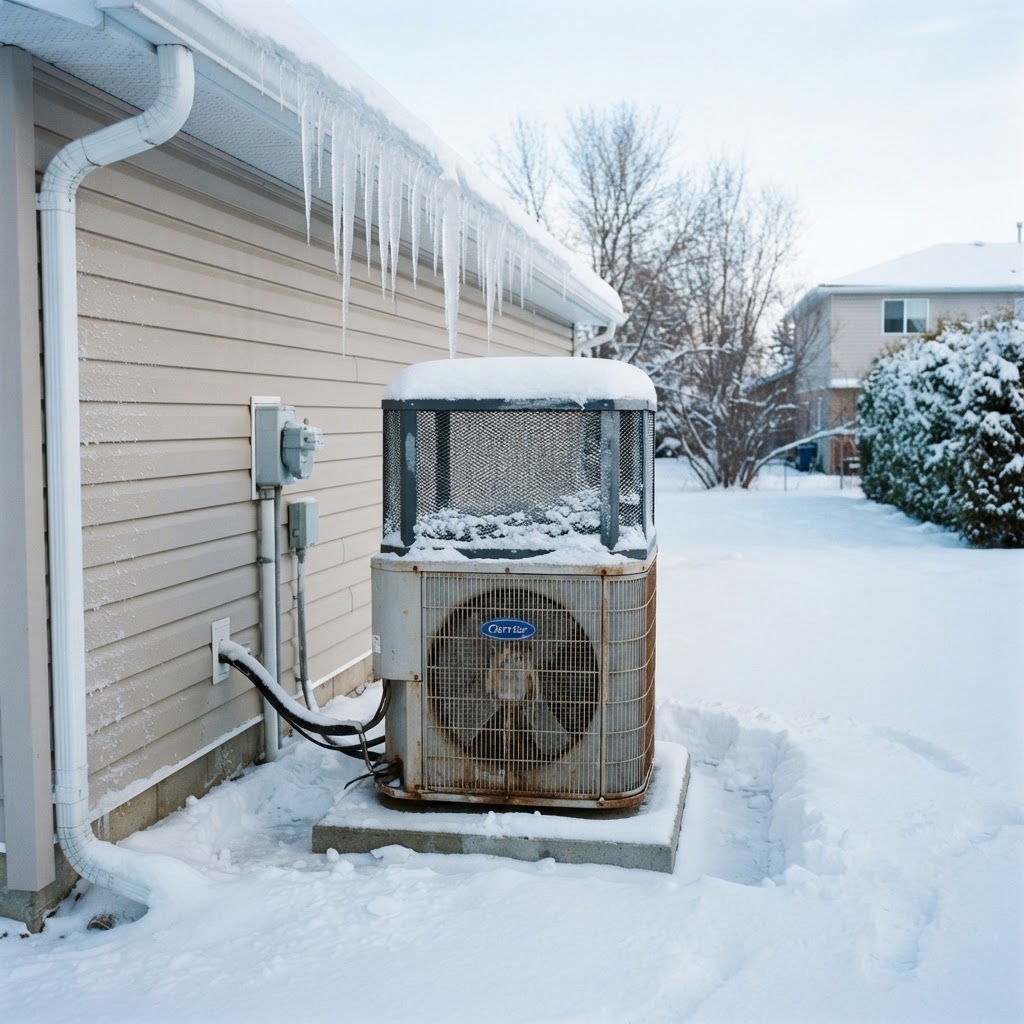
- Broom the top clear after a big snowfall. Snow that melts and refreezes bends fan blades and splits grilles. Two minutes with a broom a few times a winter is enough.
- Watch the roof above it. If the unit sits under an eave or in a valley, that is where the icicles and sliding snow come from, and that is where the damage happens. Roof-edge ice management, or a deflector above the unit, is a better fix than armouring the unit.
- Break the drift, not the airflow. A low fence or a hedge upwind can knock down our northwest wind-driven snow, but anything that closes the cabinet off from air is worse than the drift.
- Walk around once after each freeze-thaw cycle. Ice on the outside of the top grille is normal weather. Ice that has built into the base pan or through the fan opening is not.
The indoor half you should not skip
The outdoor unit gets the attention, but the indoor half of the system is where November surprises come from.
- Change the furnace filter. The blower is shared by heating and cooling, and a loaded filter strains both.
- Flush the condensate drain and trap. The cooling coil drains through a small line and trap, often tied into the high-efficiency furnace drain. A plugged trap can trip a furnace pressure switch and shut down your heat in January, or overflow onto the floor. Flush with water, and a splash of vinegar helps keep the slime down.
- Look in the drain pan. Standing water, rust or a jelly-like film means it needs cleaning now.
- Set the humidifier for winter and replace the pad if it is scaled or clogged.
- Check the furnace room for a disconnected flex duct or a duct run knocked loose during summer work. It is an easy thing to spot in fall and an expensive thing to heat around all winter.
If you have a heat pump, do the opposite
A heat pump outdoor unit is not going into storage. It is your furnace from now until April, and it needs to be clear, powered and uncovered.
- Keep the power on and the cover off. No exceptions.
- Keep the top and sides clear of snow. A packed or buried unit loses capacity and spends its life in long defrost cycles.
- Keep the base pan drain clear so defrost water runs away instead of refreezing around the coil.
- Consider a stand or bracket if the unit sits at grade and gets buried every year; raising it above normal snow depth is the single biggest winter performance upgrade. That work involves the refrigerant lines, so have it done properly.
- Keep the snowblower away from it. Gravel and ice thrown at 200 km/h through a coil is a repair, not a clearing.
- Ice on the top during a cold snap can be normal defrost behaviour. A solid block that never clears, or a unit that only heats on auxiliary while the outdoor fan sits still, is a service call. You still have backup heat, so there is no emergency, but do not cover it and wait for spring.
Window and portable units
Different equipment, same season. Take window air conditioners out before the first hard freeze: a unit left in is a heat leak, a water intrusion point and an iced-up drain pan. Clean the filter, tip it to drain, and store it indoors. Portable units get drained, filters cleaned and stored dry.
While you are at it, this is the same afternoon to look at how water behaves around the foundation, since fall is when grading and downspouts are either doing their job or quietly causing next spring's problems. Our article on drainage and waterproofing around a Winnipeg home covers that side of the fall walk-around.
Restarting in spring
- Uncover, clear the debris, and check for nests and chewed wiring before restoring power.
- Put the breaker and the outdoor disconnect back, then wait up to 24 hours before calling for cooling so the crankcase heater can warm the compressor oil. This matters most after a cold spring night.
- Run it on a mild afternoon, then check a supply register near the furnace; the air should feel roughly 8 to 11°C cooler than the room once it has run for ten minutes.
- Ice on the large suction line while cooling is not normal, and neither is a repeated start-stop cycle. Both point to a refrigerant charge problem.
- Book the tune-up in April, not during the first July heat wave when every technician in the city is booked solid.
What skipping it can cost
These are typical Winnipeg price ranges for the work involved as of 2026, and they move with parts and labour. Get two quotes for anything beyond a service call.
| What went wrong | Why it happened | Rough range |
|---|---|---|
| Coil packed with debris, bent fins | No fall cleaning; poor airflow and high head pressure | Cleaning service call, or coil replacement at the higher end |
| Seized or noisy fan motor | Moisture and freeze-thaw sitting in the motor | $400 to $900 installed |
| Chewed control wiring, nest in cabinet | Unit left open and inviting all winter | $200 to $600 to diagnose and repair |
| Cracked insulation, iced line set | Sun-rotted foam never replaced | Under $50 in materials, or a service call if ignored |
| Compressor failure | Years of strain from restricted airflow or cold-weather operation | $1,500 to $3,000 and up, or full system replacement |
Against that, an afternoon with a garden hose, a fin comb and a piece of plywood is cheap insurance. If the unit is older and the repair quotes start climbing, it is also worth knowing what a comparable home with newer mechanicals is selling for; current Winnipeg listings are a quick reality check, and a home valuation puts a number on your own house before you decide whether to repair or plan a replacement.
Winnipeg fall A/C checklist
- Cooling switched off before outdoor temperatures drop below about 15°C
- Thermostat set to heat, fan on auto
- Outdoor disconnect pulled and A/C breaker off, breaker labelled
- Cabinet cleared of leaves, debris and nests; wiring checked for chew marks
- Condenser coil washed from the inside out, fins straightened
- Line set insulation intact and replaced where cracked
- Pad level, brackets tight, roughly 60 cm clear around the cabinet
- Ventilated top cover on, or unit left open to the air, nothing stored on top
- Furnace filter changed, condensate drain and trap flushed, drain pan clean
- Photo and date recorded
- Snow cleared from the top after each major snowfall
- Heat pump? Power on, no cover, snow kept clear all winter
Frequently asked questions
Should I cover my air conditioner for a Winnipeg winter?
A ventilated top cover, yes. A full plastic wrap, no. The top cover keeps snow and ice off the grille and fan; wrapping the whole cabinet traps moisture and rusts it from the inside while giving mice a place to nest. Many units will survive fine uncovered, but if the unit sits under an eave or a roof valley, protect the top.
Do I need to turn the breaker off for the air conditioner in winter?
Yes, for a cooling-only air conditioner. Pull the outdoor disconnect and switch the breaker off, which protects the unit from accidental starts and from any electrical issue while it sits idle. A heat pump is the exception: it runs all winter and must stay powered.
Can I run my air conditioner in October if the house gets warm?
Not once outdoor temperatures drop below about 15°C. Cold, thick compressor oil does not lubricate properly, and liquid refrigerant can reach the compressor. Use windows, a fan or a portable unit instead, and let the system rest until spring.
How much does an A/C tune-up cost in Winnipeg?
A seasonal clean and check is normally a modest service call, far less than a fan motor or compressor repair. Spring is the better time to book, before the summer rush; the fall shutdown is the part most homeowners can do themselves.
Is it normal for my heat pump to have ice on top in winter?
Some frost and ice during a defrost cycle is normal. A solid block that never clears, ice that has built into the base pan, or a unit that only heats on auxiliary while the outdoor fan stays still is not, and it should be looked at. Do not cover the unit to “help” it.
What if my outdoor unit is already buried in snow?
Clear the top and the sides with a broom, not a shovel, and do not chip at ice with a metal tool. The coil and fan are easy to bend. Once it is clear, keep after it after each snowfall; a buried unit loses efficiency and strains the compressor.
Next steps
If you are buying a home this fall, walk around the outside unit during your showing: a clean coil, intact insulation and a level pad tell you someone has been taking care of the mechanicals. If you are selling, this checklist is a cheap way to answer the mechanical questions a buyer's inspector will ask. For plumbing and mechanical issues that show up in older Winnipeg homes, our piece on Poly-B plumbing is a useful companion read.
When you are ready to talk about a purchase, a sale, or what your home is worth before you spend money on repairs, I am happy to walk through it. Reach me at 431.306.2240 or through the contact page.

Mark Goldade, Personal Real Estate Corporation
Royal LePage Prime Real Estate · 431.306.2240 · Published November 3, 2026
This article is general maintenance information, not a manufacturer's instruction or a substitute for a licensed HVAC technician. Follow your own equipment manual and local codes.